Background
Active Galactic Nuclei (AGN) are among the most massive and energetic objects in the universe, which makes them key to understanding galactic morphology. One of the fundamental values when characterizing an AGN is its mass.
Methods for getting an AGN's mass are based on the virial theorem and need two values:
- Rorbit, the distance from the center of the supermassive black hole to the broad line region (BLR). The BLR is a region of gas that emits Doppler-broadened emission lines because of its high velocities and its proximity to the ionizing radiation from the accretion disk.
- Vorbit, the velocity of the gas in the BLR.
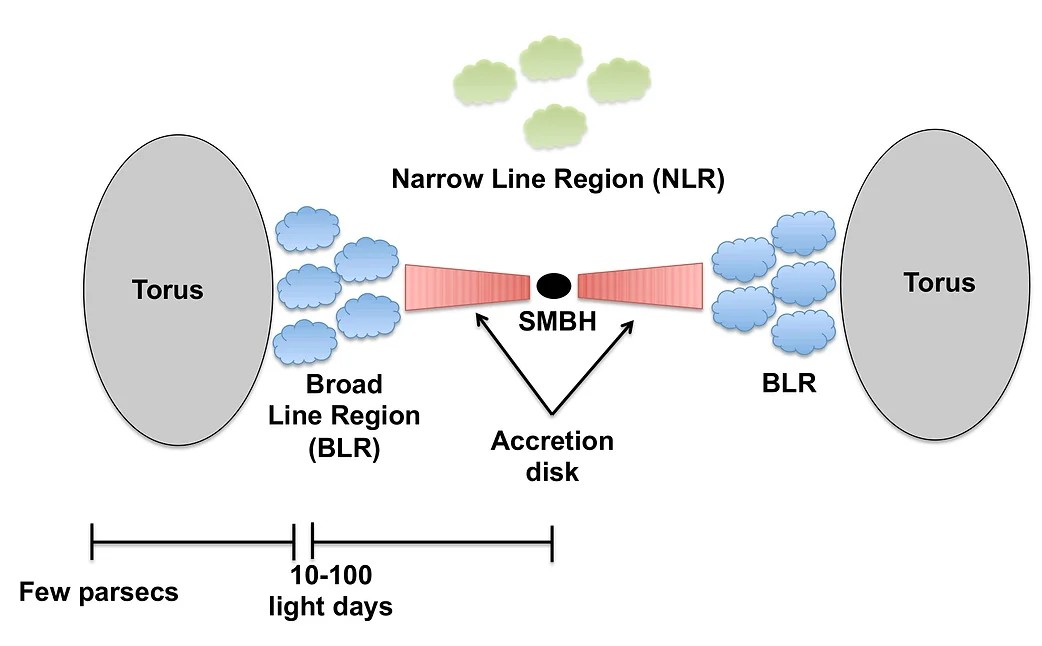
The most rigorous of these methods, reverberation mapping, can take years to get the first of those two values for just one object. That's why quicker and more automatable (if less rigorous) methods are desirable.
One such method, the one I use, uses a correlation between the monochromatic luminosity at 5100 Å and Rorbit to estimate Rorbit.
What I did
Starting in June 2023, I wrote a Python script to estimate black hole masses from SDSS spectral data, using a Python package called PyQSOFit (Guo, Shen & Wang 2018). With PyQSOFit I obtained the FWHM of the Hβ emission line and the monochromatic luminosity at 5100 Å for about 5,000 AGN from the catalog described in Souchay et al. 2019.
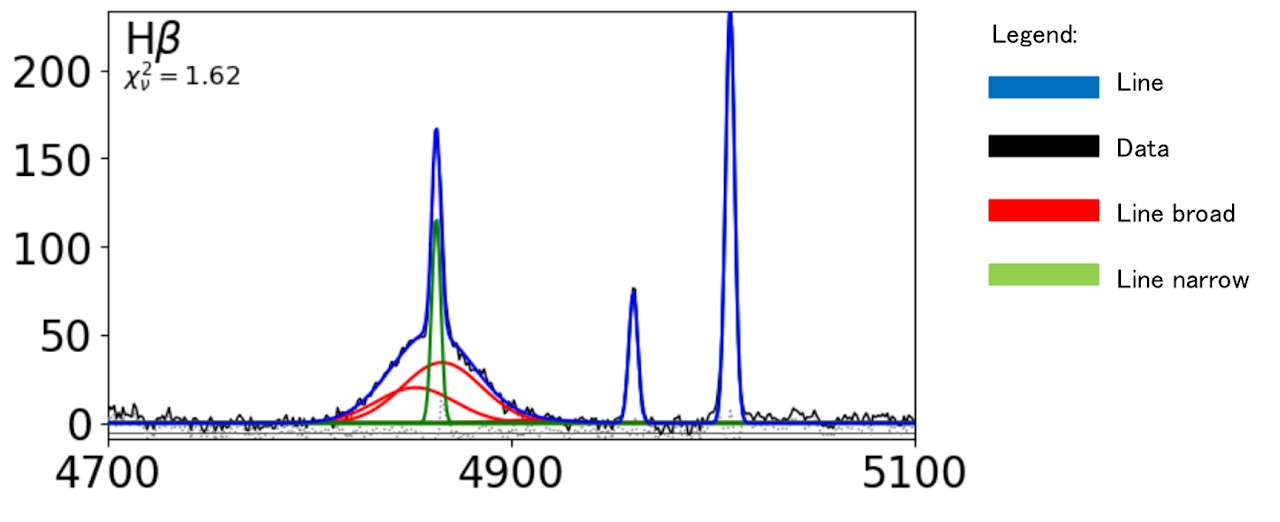
Then, using the empirical relationships in Vestergaard & Peterson (2006), I estimated the masses of about 5,000 black holes.
Results
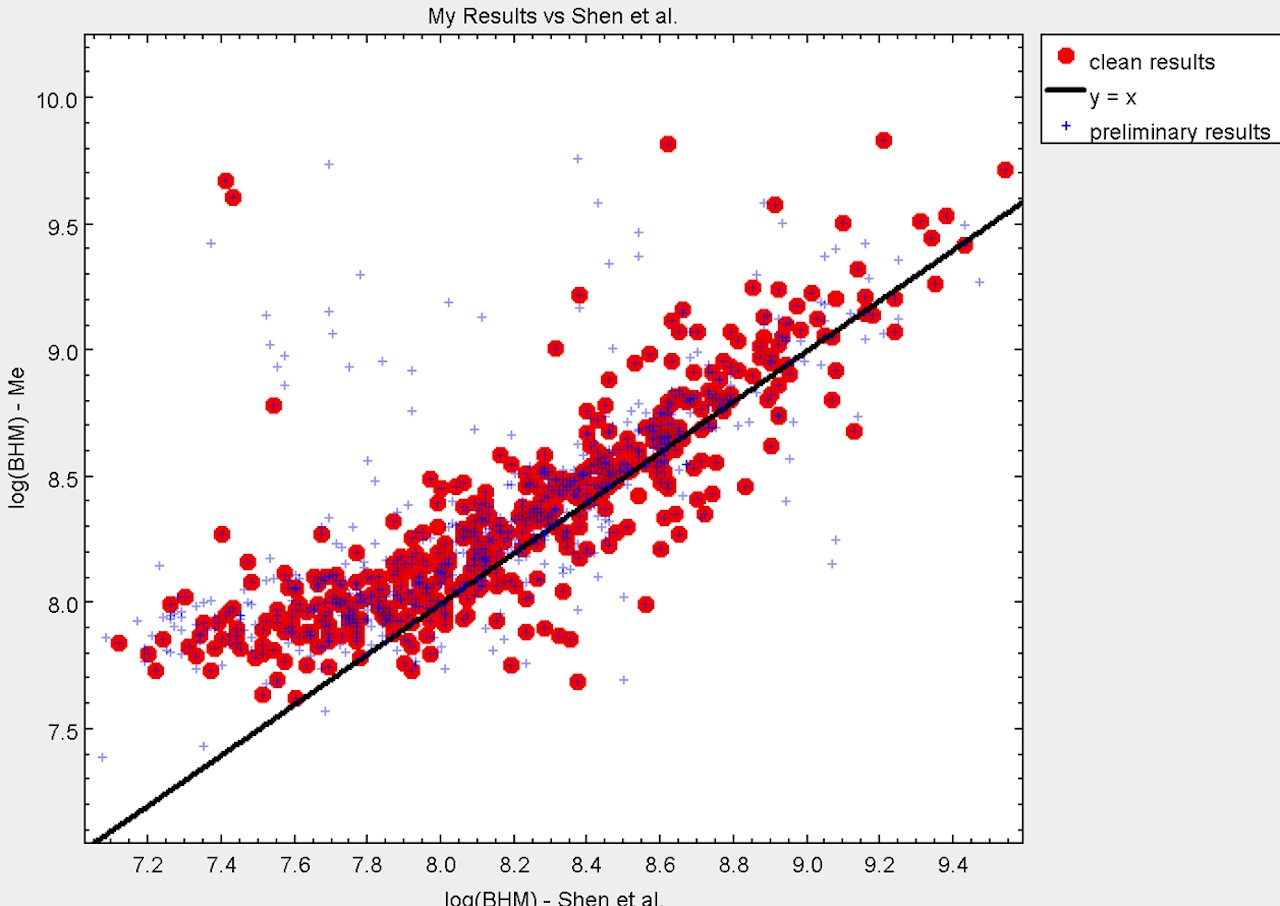
The plot below compares several hundred of these masses with those estimated by Shen et al. The "clean results" are the objects with an Hβ FWHM above 1,000 km/s (Type 1 AGN) and a signal-to-noise ratio above 10.